January 2, 2012

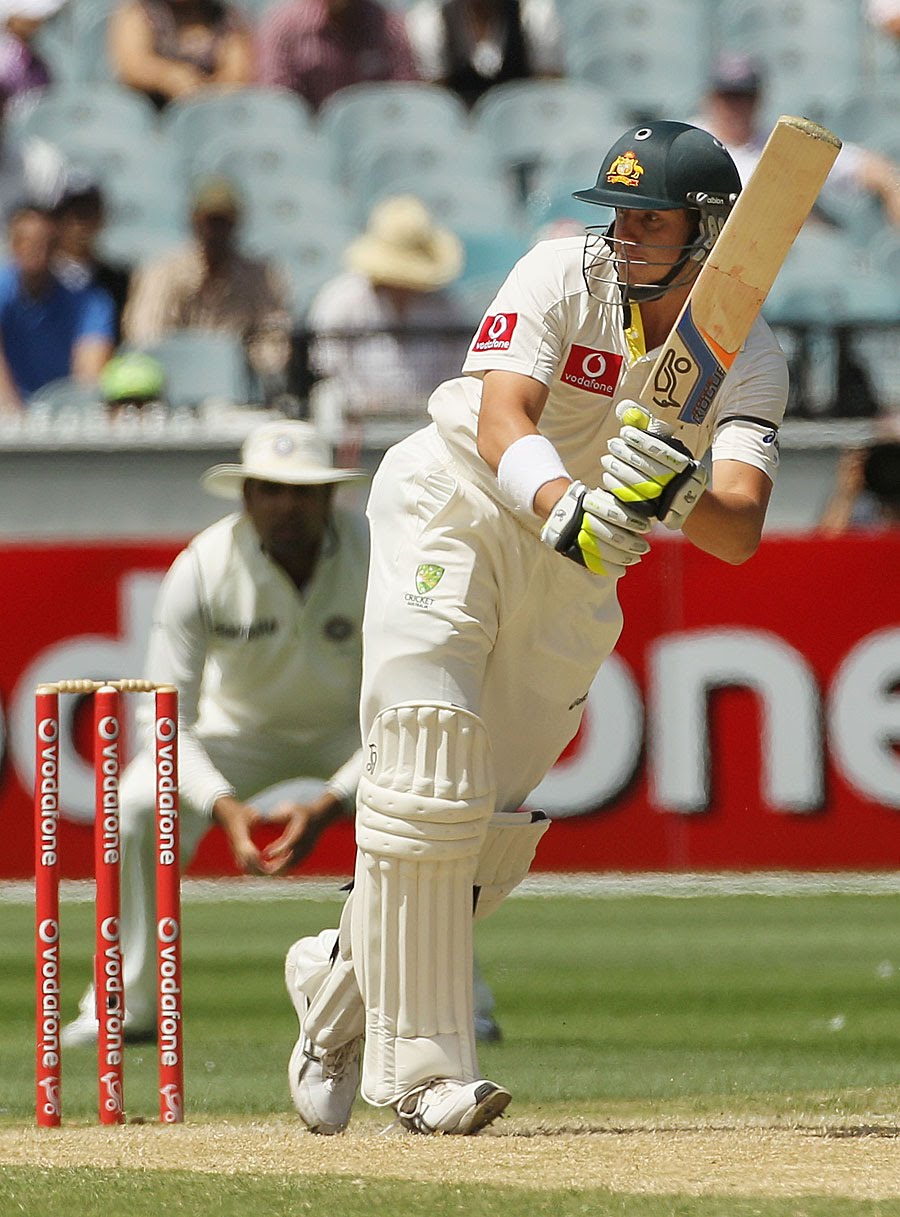
Not so happy birthday Rahul Dravid!

.
0 comments

By Syed Khalid Mahmood

Rahul Dravid is turning 39. In fact he will be reaching this ‘milestone’ of sorts a few hours earlier on January 11, 2012 by virtue of being in Australia rather than in India.

He is at the stage of life when the increase in the number of burning candles in birthday is not a welcome sign. He is in the 40th year of his life now, already the oldest international cricketer on show with even Sachin Tendulkar being three months younger to him.

Dravid, very appropriately titled ‘The Wall’ for his grit, determination and character, has done enough to be remembered as one of the legends of the game. His accomplishments are far too many to be summarized in a single write-up.

Cricketers like him are born once in lifetime. A team man to the core, he has had the mental strength to withstand the quickest of bowlers with minimum of fuss. While the ordinary mortals would have struggled to do it, he has succeeded in rising to the occasion more often than not.

The single greatest quality of his has been to contribute substantially when the chips are down. He’s the batsman most likely to turn the tide if the pitch has uneven bounce and the ball is doing all sorts of tricks.

Dravid’s international career spans over 15 years now. More than the quantum of runs and centuries it’s the manner and the circumstances in which he got them has immortalized him.

2011 was yet another golden year for him. Wasn’t it quite extraordinary that he continued compiling runs when the others failed in demanding conditions? He scored prolifically in the West Indies where the balls kept terribly low on most of the surfaces. Then he stood up against the England bowlers in conditions that were different altogether.

The tour of Australia, starting with the Boxing Day Test in Melbourne, was surely going to test the high-profile Indian batsmen and Dravid was most likely to be the leading run-getter once more.

That has not happened yet and the Indians are in shambles, having lost the first two Tests and not much hope going into the last two. The scenario is not alien to them. They were in similar situation in Australia four years ago too.

It was Dravid who had led the turnaround in 2008 by topscoring in the Perth Test where India registered a famous victory against the heaviest odds.

Perth is again the venue. The Indians appear down and out. Will Dravid, in his 40th year, come up with another magical performance to prove the so-called experts wrong who are predicting another whitewash?

Dravid may not be in the ideal frame of mind at this stage, having been undone by the young Australian speedsters but he has the knack of bouncing back with vengeance. He holds the key to India’s fortunes today. If he gets a couple of big scores things could change dramatically.He certainly has the skill, patience and will power to deliver once.

readmore »»

December 29, 2011

India fail to overcome traditional weaknesses to lose yet another Boxing Day Test

.
1 comments

By Syed Khalid Mahmood

India succeeded in fielding their full strength playing eleven in the first Test against Australia at the Melbourne Cricket Ground but could not overcome the traditional weaknesses to lose yet another Boxing Day Test.

With the pace trio of Zaheer Khan, Ishant Sharma and Umesh Yadav firing on all cylinders and all their world-class batsmen very much there, India had the best chance to topple the Aussies in their own den. Despite having the game in control for the better part of four days, India lost it by 122 runs.

This was a rare occasion when India didn’t have a pedestrian seam bowler to support the new-ball operators. In fact it was after very long time when they were in possession of a potent pace attack that possessed the capacity to rattle the opponents.

Zaheer, Sharma and Yadav bowled their heart out on the responsive track and they had the Australian batsmen guessing and fending. It was an unusual sight watching the Indian speedsters clocking 150 kilometers per hour consistently.

The Australian batsmen were themselves short of confidence and they were tested by the cracking deliveries that were being hurled at them. The Indian fast bowlers broke the back of Australian batting in both innings. But as we have seen more often than not, the tail-enders spoiled their party.

Starting from the first-ever Test that Indian had played at Lord’s in 1932 they have had a history of letting the opposition off the hook after holding them hostage for a while. The history now repeated itself at Melbourne in 2011.

In both the innings the Australian tail-enders put together crucial runs that proved decisive in the low-scoring game.

India also have had the habit of collapsing against the run of play. They were in complete command of the situation on the second evening when Rahul Dravid and Sachin Tendulkar had brought up 200 of the innings for the loss of only two wickets. Who would have believed them getting bowled out for well below 300 from such strong position and confronting inexperienced bowlers.

It was yet another Test match which India dominated but failed to win it. They had themselves to blame for not having exercised total control when they were in a position to do so.

"We thought with a 230-odd runs lead, if we could get them for 240 or 250, that's a very gettable score. But I felt 290-odd was also a score we should have achieved. The wicket was good. It was not like there was too much wear and tear on the wicket. I think the batting line-up flopped in both the innings,” skipper Mahendra Singh Dhoni reckoned.

"First innings, we got off to a decent start. We had a kind of a partnership going, after that we needed to capitalize on it. We were not really able to do that, because of which we were close to 50 runs short. In the second innings, wickets kept falling at regular intervals, which meant getting close to 300-odd runs was more and more difficult. Just that we need to get consistent with our batting,” he believed.

readmore »»

December 26, 2011

International sports returns to Pakistan with hockey series against China

.
0 comments

By Syed Khalid Mahmood

China are not a superpower in the hockey arena yet but their recent tour to Pakistan attained great significance because it announced the revival of international sports activities in the country which seemed to have become ‘out of bounds’ for the visitors since early 2009.

The Chinese hockey team opened their tour with the first couple of Test matches at the Hockey Club of Pakistan Stadium, Karachi, before moving on to Faisalabad and Lahore for the last two Tests against the Green-shirts.

The hockey Test series between the two nations could open the gate for resumption of other sporting events in Pakistan as well. Already there are indications that Bangladesh’s cricket team would be arriving here early next year.

So there’s every possibility of Pakistan playing host to quite a few nations in hockey and cricket in particular in the coming year. The entertainment-starved people of Pakistan are crazy about sports and they eagerly await revival of international contests in their own backyard.

International hockey resumed in Pakistan after a staggering gap of seven years when the Green-shirts took the field against China at the Hockey Club of Pakistan Stadium, Karachi, on December 21. The hosts celebrated the occasion by winning the first Test by three goals to nil. It was the first international hockey game to be staged in Pakistan after the 2004 Champions Trophy at Lahore.

Although the Chinese showed flashes of brilliance in all the four Tests they were unable to stop the Asian Games Champions from completing a clean sweep.

But more important than the result was the return of international sports action in Pakistan. The Federal Interior Minister, Rahman Malik, who was chief guest in the opening game, expressed his pleasure over the resumption of international sports activity in the country with the arrival of Chinese team for a four-match hockey Test series.

The Pakistan Hockey Federation (PHF) President, Qasim Zia, its Secretary Asif Bajwa, Chief Selector Hanif Khan, Olympians Hasan Sardar, Danish Kaleem, Salim Sherwani, Ahmed Alam and Secretary of Karachi Hockey Association (KHA) Farooq Khan, were also present in the glittering opening ceremony.

“It’s a historic day for Pakistani sports and I hope in coming years more foreign teams of cricket, hockey and other sports will be visiting Pakistan without any security issue,” Rahman Malik told the media corps after shaking hands with players of Chinese and Pakistani teams and officials.

“We are grateful to brotherly country China for sending their hockey team to Pakistan to resume international sporting activities here,” he commented.

The Interior Minister, who was appointed Patron of the PHF earlier this year, said that the government was very keen and making all-out efforts to bring international sports back to Pakistan after 2009 attacks on Sri Lankan cricket team in Lahore.

Meanwhile the Sindh Governor Dr. Ishrat Ul Ebad Khan, during his visit to Hockey Club of Pakistan Stadium the following day, announced the laying of a new blue astro-turf at the stadium to further boost the national sport.

"The Sindh Government will be providing funding for the new turf at the HCP replacing the current green turf which was laid here in 2004," he said after watching the second Test between Pakistan and China on December 22.

readmore »»

December 17, 2011

Pakistan’s greatest sports administrator Nur Khan is no more

.
0 comments

By Syed Khalid Mahmood

In my estimation Air Marshal Nur Khan was Pakistan’s greatest-ever sports administrator whose era was full of accomplishments and glories. His leadership qualities were second to none but even more inspirational were his traits of bravery and fortitude. He was a dynamic person who believed in innovation and bright new ideas.

His contribution to sports as well as the armed forces has been legendary. He was widely respected his integrity besides his razor-sharp intelligence and outstanding management abilities. He passed away quietly at the Combined Military Hospital in Rawalpindi on December 15 where he had been admitted just three days ago when suffering from chest infection. He was 88.

Air Marshal Nur Khan served with distinction as the Commander-in-Chief of the Pakistan Air Force from July 1965 to July 1969. He later was appointed Governor of West Pakistan in August 1969.

He was instrumental in the take-off of the country’s national carrier, Pakistan International Airlines (PIA), during his tenure as Managing Director from 1959 to 1965. Upon the special request of the government, he was reappointed as head of PIA in 1973.

He turned around the destiny of Pakistan sports with his visionary approach. He headed the controlling bodies of hockey, cricket and squash and brought about revolution of sorts by introducing policies that yielded results.

Pakistan won the Olympic hockey gold in 1968 and 1984, when he was at the helm of the affairs in the Pakistan Hockey Federation (PHF). He conceived the World Cup as well as the Champions Trophy. Pakistan remained a superpower in hockey until he was there.

The Air Marshal led the cricket board from 1980 to 1984. The World Cup, whose first three editions were held in England, came to the sub-continent mainly due to his initiatives. He also pioneered the idea of neutral umpiring.

Pakistan reigned supreme in squash as well during his era. He was chiefly responsible for developing infrastructure that produced world champions Jahangir Khan and Jansher Khan.

He commanded awesome respect from all quarters even after retirement and we same its glimpses during a reception that was organized in his honour by the Brotherhood Sports Society of Pakistan (BSSP) in Karachi in March 2007.

I have attended and covered innumerable receptions over the years but this was one unforgettable evening on many counts. The Darbar Hall of Hotel Sheraton was packed to capacity as the session of speeches, in which glowing tributes were paid to Air Marshal Nur Khan, lasted more than two hours.

There was a long list of dignitaries who desired complimenting the Air Marshal but the organizers had to curtail it due to time constraints. Those sitting in the audience were luminaries of their respective fields. Hardly would one find so many living legends under one roof.

Hosts Waqar Hasan, himself a dashing cricketer of Pakistan’s early years, and General Tauqir Zia, a former Chairman of the Pakistan Cricket Board (PCB), showered Air Marshal Nur Khan with the kind of praise that he so richly deserved.

During the entire length of the programme not a single soul was observed making any movement. Everyone was glued to his or her seat. The Air Marshal was the last speaker and what a speech he delivered. The applause he received had reflected his immense popularity and unmatched respect.


readmore »»

December 15, 2011

Will India thunder Down Under to rewrite history?

.
0 comments

By Syed Khalid Mahmood

As expected there’s great buzz and excitement on the eve of another Australia-India series. The battle is set to resume with the Boxing Day Test in Melbourne which will be followed by three more Tests before the series of One-day Internationals and Twenty20 Internationals.

The majority of the contests between the two sides, particularly Test matches, have been fiercely fought ever since India turned it around in Kolkata in 2001. They have been engaged in the most awesome of duels during the last 10 years or so.

What’s in the store for the enthusiasts in both the countries and rest of the cricket fraternity during the next few months? Will we watch another classic series with packed houses in Australia and glued television audience in India?

Will the embattled Aussies, having far too many chinks in their armour, survive the rejuvenated Indians, who have redeemed themselves with consistent performance in their own backyard after having suffered a whitewash in England earlier in the year?

Will India register their first-ever Test series win on the Australian soil? Will the energetic Indian speedsters, possessing venom and accuracy but lacking in experience, bend their backs to make life miserable for the home batsmen? Will the potent but inexperienced spinners come good on their maiden overseas assignment?

These are some of the questions that must be baffling the cricket buffs. On paper the Indians have a formidable batting line-up which has skills, temperament, expertise and most importantly the hunger to pile on the runs. With established batsmen like Virender Sehwag, Gautum Gambhir, Rahul Dravid, Sachin Tendulkar, VVS Laxman and Mahendra Singh Dhoni, in their ranks India should not be short of runs during the Test series.

All of them are class acts with proven record in every corner of the world. I don’t think anybody will doubt their capability to get heaps of runs. Even on the Australian tracks where the ball will bounce much more than it does in India, they are expected to be scoring freely. All of them, including Dravid of late, believe in taking the attack to the opposition.

The new crop of Australian fast bowlers looks as sharp and as dangerous to what one is used to watching there but they might be taught a few lessons by the accomplished Indian batsmen, who do have the rare ability to graft. With no Glenn McGrath or Shane Warne to face the Indian batter should be fancying their chances of posting big scores without much hassle.

India would be banking on their batsmen to put them in positions of strength. Their bowlers will obviously stand a greater chance of picking up wickets if they operate with attacking fields rather than been assigned the task of just choking up the runs.

The Australian batting has looked fragile during the ongoing season and they could be put to severe examination by the Indian bowlers on the lively pitches which produce results more often than not. The hosts may still be in trouble if the surfaces assist the spinners. Well India do have probably the best chance ever to rewrite history.


readmore »»

December 12, 2011

Double-centurion Sehwag can do it again and again

.
1 comments

By Syed Khalid Mahmood

No matter what the experts might say or irrespective of what the stats tell you Virender Sehwag happens to be one batsman whose solo on any given day can upstage any band anywhere.

The pitch on which he is playing or the quality of bowling he is confronting become secondary when he is on song. When his hand-eye coordination gets right he will plunder any attack of the world with minimum of fuss.

He’s not one of those cricketers who have to depend on footwork or technique. He has every shot in the book. He is not afraid to walk down the wicket to heave what would be a decent ball for other batsmen.

Sehwag lives dangerously for he continues to chance his arms until he gets out. While every batsman needs time to get his eyes in before stroking the balls powerfully he gets into top gear from the moment he takes guard from the umpire.

I don’t think anyone would have been surprised with his recent double-century against the West Indies at Indore which eclipsed Sachin Tendulkar’s highest score of 200 in One-day Internationals. Now Sehwag holds the OID record of highest individual score by smashing 219 off 149 balls on December 8, 2011.

In fact it was another case of missed opportunity. He had enough time at his disposal to become the first batsman ever to score 250 in an ODI innings but he couldn’t stay there until the end.

Tendulkar, who holds virtually every conceivable batting record in Tests as well as ODIs, may find it rather difficult to reclaim this one from Sehwag, who has the capacity to score more briskly than any contemporary batsman.

I think Sehwag, who has a couple of triple centuries in Test cricket, can score a few more of those besides recording more double-hundreds in ODIs. He has the rare skill as well as the temperament to keep doing it again and again.

"I am happy to have broken my role model Sachin Tendulkar's record. It won't be easy for people to score double hundreds. Over the last so many years only two have done it. This opportunity will come only once in a lifetime and I am happy I have taken it. I dedicate this knock to my father who is no longer with us,” Sehwag was quoted as saying after his swashbuckling knock.

"It is one of my very best innings. Unlike in Test cricket when one can bat longer, in one-dayers you have to keep an eye on the run-rate. The wicket was very good for batting but the bowlers are also trying to get you out,” he added.

"It was a true batting wicket. Whenever I hit the ball into the gaps, it would go for four. Whenever I decided to hit a six, I would hit with a straight bat and it would go for six. The first time the double-century crossed my mind was during the batting Powerplay between the 35th and 40th overs,” Sehwag disclosed.

readmore »»

November 29, 2011

Revisiting living legend Jamsheed Marker

.
0 comments

By Syed Khalid Mahmood

I did have the honour of interacting with the legendary cricket commentator-turned diplomat, Jamsheed Marker, on a few occasions in the past but my first-ever one-to-one meeting with him took place on November 29, 2011.

Although he has quietly celebrated his 89th birthday a week ago he’s still full of energy and he has a very sharp memory. He keeps himself busy all day in scholastic activities. He hasn’t lost the passion to walk daily, despite problems in his back, which restrict his movement otherwise.

It was more of a privilege than just pleasure having shared views with him for over an hour at his Bath Island residence in Karachi. The beautiful house itself holds a place in history for it was constructed way back in 1865. It’s the home built by his grandfather.

There is a hardly any mention of cricket in his autobiography ‘Quiet Diplomacy’ a copy of which he was kind enough to sign for me but Jamshed Marker continues to have a love affair with sport that had made him a household name in the 1950s and 1960s.

The great Omar Kureishi, with whom he had formed a formidable duo, used to describe cricket as his first love. It doesn’t seem much different to Jamsheed Marker, who has remained a keen follower of the game all along.

Jamsheed Marker and Omer Kureishi, both of whom were buddies, were credited to have made radio commentary an art. They ruled the hearts of the cricket enthusiasts with their voice and depth of knowledge.

While Omer Kureishi continued to do cricket commentary for a long time, Jamsheed Marker had to abandon doing it at the start of his diplomatic career in 1965 when he was posted as Pakistan's ambassador to Ghana. And what a career he has had. Truly fabulous to say the least!

He is listed in the Guinness Book of Records as having been ambassador to more countries than any other person. After Ghana he represented Pakistan in Romania, Bulgaria, USSR, Finland, Canada, Guyana, Trinidad and Tobago, East Germany, Iceland, Japan, West Germany, France, the United States and finally the United Nations in New York City. He served as Ambassador of Pakistan continually for 30 years, in 10 different capitals, and nine further concurrent accreditation.

Prime Minister Shaukat Aziz appointed Jamsheed Marker as ambassador-at-large for his years of service in September 2004 while he was awarded an honorary doctorate by Forman Christian College University, Lahore, in June 2011.

He has been acclaimed as one of the most respected diplomats on the international circuit. He had a long and colorful innings as a diplomat following a brilliant stint as a cricket commentator.

Interestingly, during the majority of years in his long diplomatic career, he was posted in countries where cricket wasn’t the number one sport.

He has fond memories of a reunion with the Pakistan cricket team, with Omer Kureishi being manager, when they toured England in the summer of 1974. He vividly remembers watching the Lord’s Test with his great friend.

readmore »»

November 24, 2011

Was the 1996 World Cup semifinal really fixed?

.
1 comments

By Syed Khalid Mahmood

Vinod Kambli, who was left stranded in that infamous semifinal encounter which referee Clive Lloyd had to award to Sri Lanka against India at the Eden Gardens, Kolkata, in March 1996, has come up an interesting observation or if you call it an allegation more than 15 years later.

Left-handed Kambli, who watched from the non-striker’s end his illustrious colleagues fall in a heap in the most dramatic of fashions, has expressed suspicion over that particular game being fixed. It’s entirely up to you whether you disregard it as a publicity stunt or get some feeling in mind that indeed there was something terribly wrong.

The fierce reaction of the Indian captain, Mohammad Azharduddin, that has followed has probably alerted more people than it could have been if the charges were ignored. May be he thought of defending himself in the media because he holds a public office but that might also backfire.

But Kambli is talking about an era when every other match appeared to have been fixed. He has probably chosen to target the 1996 World Cup semifinal because he was there until the end, having broken into tears as well.

Azharduddin, who was known for his artistic stroke-play, has clarified his position by blasting Kambli and passing a few unkind remarks that were hardly needed.

It doesn’t matter if you believe in Kambli or Azhardduin but there had been instances in the past as well and not surprisingly they happened afterwards too when a few of the high-profile World Cup matches seemed to have been victimized or influenced by the outside forces.

Both the semifinals of the 1987 World Cup, in which co-hosts Pakistan and India got eliminated against the heaviest of odds, were alleged to have been fixed. The final of the 1999 World Cup at Lord’s also remained a subject of discussion for the wrong reasons for a long time.

Kambli’s specific allegations about the 1996 World Cup semifinal between Indian and Sri Lanka make some sense because of the presence of the some ‘suspicious’ elements in the ground and whose movement remained unchecked.

Not much could be done now. Neither the Scotland Yard nor the Police authorities of any other country can investigate in such matters having taking place some 15 years ago. It’s going to be next to impossible to discover any solid evidence to book a case against the culprits.

I am sure the International Cricket Council (ICC) and the Board of Control for Cricket in India (BCCI) have more important things to do than to probe the matches of the past. They may loathe the idea of investigating a recent foul play, let alone an incident that occurred so many years ago.

It’s an open secret that match-fixing and spot-fixing have remained rampant in international cricket for ages and there are a number of matches that have appeared to have been manipulated in illegal manner.

There’s very little hope for the practice to be stopped but yes some strict measures can prevent the sport from becoming a farce.

readmore »»

Recent Posts