September 3, 2010

Kapil Dev desires Imran Khan to run Pakistan cricket

.
0 comments

By Syed Khalid Mahmood

The spot fixing scandal having marred Pakistan’s ongoing tour of England has brought to light a few tales of the unexpected and on top of them is Kapil Dev’s statement in which he has heaped lavish praise on Imran Khan, one of his illustrious contemporaries, now heading a political party.

Alongwith Richard Hadlee of New Zealand and Ian Botham of England, both of them knighted later, Imran Khan and Kapil Dev formed the quartet of the greatest all-rounders to have ruled the world in the 1980s. All of them brought unmatched glories for their respective countries.

Kapil had led India to victory in the 1983 World Cup against the heaviest of odds while Pakistan were crowned as the world champions nine years later, under Imran, in not too dissimilar circumstances

Kapil has now called upon Imran to help Pakistan restructure itself around morals, ethics and values in light of the match fixing that has come to light.

“I appeal to Imran Khan to take charge of the current situation in Pakistan. Being the cleanest player, it’s he who can save and look after Pakistan cricket. None of us want the game in Pakistan to be finished, as this is one country that has produced some of the finest cricketers,” he stated.

Kapil appears convinced that Imran remains the ideal man to run Pakistan cricket after so many scandals have damaged it over the years.
He described Imran as the “cleanest and the strongest” person in the country to fix the downward trend of cricket in Pakistan.

“In this time of crisis, I can only think of Imran as the cleanest cricketer to look after Pakistan cricket. He can really put the nation out of this controversy and other ones because he also has a strong personality and a sharp mind,” Kapil reckoned.

Kapil has spoken quite highly of Imran. I can’t recollect of Imran having ever expressed similar sentiments for any of his contemporaries.

The former Indian all-rounder, who also held the world record for the highest number of wickets for sometime, had sympathy for the Pakistan cricketers but also reiterated that those found guilty of it should be taken to task.

“I do feel sorry for Pakistani cricketers and Pakistan cricket. But at the same time, the alleged ones should be severely punished if proved guilty,” the former Indian captain was quoted as saying.

He also implored the International Cricket Council (ICC) to uphold the image of the game and get rid of people who have interests other than cricket.

“I’m not qualified to say ICC should ban players. But I appeal to the governing body to look after the game and make sure right people investigate the current issue. It should ensure that betting scandals carried out by a handful of negative people do not taint the wonderful game,” Kapil observed.

“Don’t bet on cricket,” was Kapil’s warning to the budding youth wanting to play cricket professionally.

readmore »»

September 2, 2010

PBSA assured of special government grant for Asian Games

.
0 comments

By Syed Khalid Mahmood

The Federal Ministry of Sports and the Pakistan Sports Board (PSB) have been directed to provide special financial assistance to the Pakistan Billiards & Snooker Association (PBSA) for participation in the various international events during the year.


Alamgir Anwar Shaikh, President, PBSA, has claimed that the National Assembly’s Standing Committee on Sports, headed by Iqbal Mohammad Ali, has instructed the Ministry of Sports to arrange for the necessary funds besides facilitating a foreign coach and building academies in Karachi and Lahore.

“I had a detailed session with the National Assembly’s Standing Committee on Sports in Islamabad the other day in which detailed briefing was given to them about the accomplishments and future plans of the PBSA. They recognised that snooker has brought glories to the country and there are bright prospects of our cueists bringing home more medals in the Asian Games. They advised the Ministry of Sports to meet our requirements on an urgent basis,” the PBSA President revealed.

“The Chairman of the Standing Committee was particularly appreciative of the efforts of the PBSA for generating Rs 4 million from sponsorship to offset the costs of national ranking tournaments. He agreed that that the grant of Rs 4 million the PBSA was seeking to from the government to ensure the participation of the cueists in the international events was fully justified,” Alamgir Shaikh disclosed.

The PBSA President described the meeting as extremely fruitful and he was upbeat about getting the desired support from the government in not too distant future.

“We had been given an understanding that the Federal Ministry will facilitate in hiring a foreign coach for the Asian Games for the Pakistan snooker team to participate in the singles and team events. We were awaiting the release of funds so that we could implement the plans,” Alamgir Shaikh said.

“Our cueists have a very busy international schedule and we desperately need the financial assistance from the government. Besides taking part in the 16th Asian Games 2010 at Guangzhou, China, in November we are also committed to participate in the IBSF World Championship 2010 to be staged in Syria in December,” the PBSA President pointed out.

“Then in the very next month our cueists are due to contest in the Asian 6-Red Snooker Championship 2011 to be held in China in January to be followed by the IBSF 6-Red World Snooker Championship 2011 in India in April and the 27th Asian Snooker Championship 2011 also in India in May next,” Alamgir Shaikh continued.

“With so much activity to take place in the next few months we are looking forward to the governmental support besides seeking the help of the corporate sector and the philanthropists,” he said.

Meanwhile the PBSA, confident of overcoming the financial constraints, has decided to hold the 6-Red National Championship prior to the third edition of the Ranking Cup later this year. They will be organizing the 6-Red Championship in the last week of September and it will be followed by the 3rd Ranking Cup in October.

readmore »»

September 1, 2010

Not much element of surprise in yet another scandal

.
0 comments

By Syed Khalid Mahmood

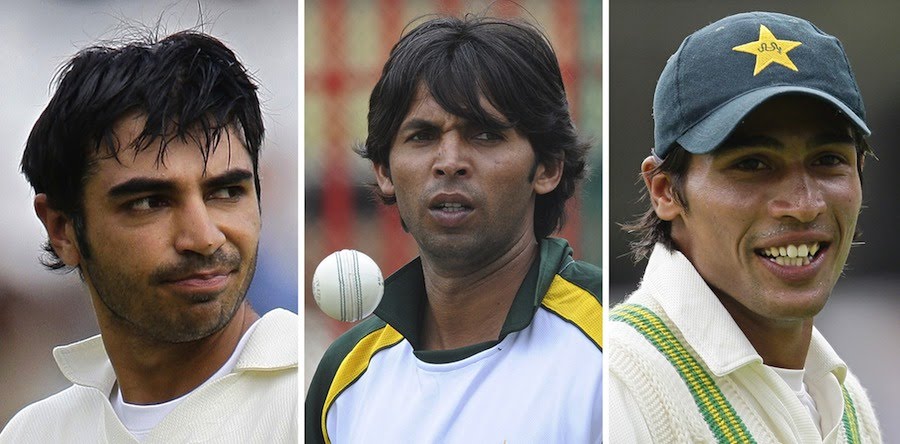
I was invited in a talk show aired live by Business Plus on August 30 in which the topic of discussion was the latest controversy having engulfed the Pakistan cricket.

Understandably nearly every television channel in the country has continued non-stop coverage of the massive scandal ever since it had broken out during the course of the fourth and final Test between England and Pakistan at Lord’s.

Anchorperson Shahzeb Khanzada had done quite a bit of research from the various sources and he was ready with probing questions as the show started immediately after the news bulletin at 8.10 pm.

Prior to the 8 pm news bulletin, the viewers of Business Plus had watched a fiery talk show featuring former Test cricketers, Sikander Bakht and Shoaib Mohammad, and sports journalist, Ehsan Qureshi.

The viewers as well as the anchorperson were stunned when I made it clear that I was not surprised when enquired about my immediate reaction at learning about the implication of a few of Pakistan’s cricketers in the latest case.

My cell phone had started buzzing once too often since the day the story was carried by the British media and my reply to everyone was that they should wait until the matter is probed before jumping into any conclusions.

The reason why I am not surprised because the Pakistan cricket has been in a state of anarchy for the last couple of years and there has been complete lawlessness ever since Ijaz Butt has been nominated as the Chairman of the Pakistan Cricket Board (PCB).

It’s the single greatest blunder by the President of Pakistan, Asif Ali Zardari, who is also the Patron of the PCB. The appointment of Ijaz Butt as the PCB chief was not viewed with suspicion because the cricket circles had expected him to mobilize the available resources for the betterment of the game.

Unfortunately Ijaz Butt has proved to be a complete failure and he has been instrumental in causing irreparable damage to the national interest. In this context the office of the President has not taken the measures to remove him despite repeated requests by the various quarters including the parliamentarians.

The situation has come to stage when you are never sure what’s coming next. With the cronies of Ijaz Butt accompanying the national team on the various tours under the cover of ‘officials’ any thing can be expected when the boys are under nobody’s administrative control.

With the aspect of discipline missing from the Pakistan camp you can always be prepared for one controversy or the other. When there is no rule of law you are always more likely to have chaos than not.

The likes of Yawar Saeed and Shafqat Rana are being obliged by Ijaz Butt on a consistent basis and the decision to involve Waqar Younis and Ijaz Ahmed in the management of the team, overlooking the recommendations of a Chief Justice, was too big an adventure.

Whatever the fate of the Pakistan cricketers in the latest case of spot fixing, one thing is crystal clear than these youngsters do run the risk of getting engaged in wrongdoings in the absence of proper guidance and lack of discipline at every level.

readmore »»

August 30, 2010

Trott, Broad save England’s blushes with record stand

.
0 comments

By Syed Khalid Mahmood

Jonathan Trott and Stuart Broad saved England’s blushes with their 332-run world record stand for the eighth wicket in the fourth and final Test against Pakistan at Lord’s that ended rather prematurely on August 29.

England had themselves to blame to be cornered at 102 for seven on the second afternoon when the likes of Kevin Pietersen and Paul Collingwood looked like novices.

The English batsmen having grown up there are expected to be well versed in tackling the conditions that are generally alien to the visitors. It was pathetic to find all their big guns perishing so unceremoniously.

Mohammad Aamer was putting the ball in the right areas and there was plenty of movement and encouragement available to him. Yet it was inconceivable to watch the England batsmen demonstrate so much weakness in negotiating him.

Trott had not come from another planet although he had certainly arrived from another continent, being a South African by birth. He applied himself and made adjustment in his stance, standing way outside his crease, to negate the prodigious swing and that was it.

Trott was on top of the bowling when the senior ‘pros’ of his team were coming and going as if they had something more important to attend. It was really shameful cricket by England that morning which saw them reduced to 47 for five, after having resumed at 39 for one.

Matt Prior got the cue from Trott and together they saw off the remainder of the morning session. But another double blow soon after resumption saw them crash to 102 for seven.

Enter Stuart Broad. He had his credentials as a lower-order batsman but not many people would have expected the young left-hander to keep his cool in the intense pressure his team was under.

It was Broad who took the initiative of attacking the bowlers who had earlier been allowed to dominate and settle into a groove. Suddenly there were positive strokes on display. Initially they went straight to the fielders and one wondered if he would have the patience to stay focused.

With his partner Trott in complete control Broad enjoyed the freedom of playing his natural game. The tactics worked and the runs started coming at a brisk pace.

The Pakistan skipper, Salman Butt, as expected neither had any backup plan or an alternate strategy to come to terms with the counter-attack. With no worthwhile advice coming from the dressing room either the momentum shifted and England moved into the driving seat.

The members of the Pakistan team management, Yawar Saeed, Waqar Younis and Shafqat Rana, were more absorbed in photo sessions at the balcony of Lord’s where they were celebrating the fall of every wicket as if that had come totally unexpected.

The partnership between Trott and Broad continued growing and it was broken only due to the technology. But the damage had been done and England merrily endured another mini-collapse to be bowled out for 446.

It was a huge first innings score and it looked even bigger when Pakistan were bowled out for 74 to concede a deficit of 372. Following on they fared little better and England won the match by an innings and 225 runs.

readmore »»

August 29, 2010

Glory for Sri Lanka, agony for India

.
0 comments

By Syed Khalid Mahmood

Sri Lanka’s task of winning the final of the Micromax Cup 2010 was made easier by the lackluster performance by the Indian batsmen once more. With the youngsters not prepared to meet the challenge and Virender Sehwag unable to translate the promising start into something substantial there was only one team that looked focused on clinching the trophy in Dambulla on August 28.

India had reinforced their batting by axing bowling all-rounder Ravindra Jadeja and bringing in Rohit Sharma. But they were unable to come good even on the easiest batting track witnessed during the competition as the ball had dominated the bat in the earlier games.

While the Sri Lankans were clinical in approach, as they normally do, the intensity was lacking in the Indian camp. The stage was set for the young guns to make amends for their past failures in the tournament but neither of them displayed the determination expected of them after having an extended run in the international arena.

Only Dinesh Karthik was unlucky to have been given out when the ball was nowhere close to his bat when he attempted to leg-glance Lasith Malinga in the opening over of the innings. On any other day that could have easily run for four leg byes but this time the ball landed in the gloves of the diving Sri Lankan captain, Kumar Sangakkara, whose vociferous appeal prompted umpire Asad Rauf to raise his finger.

Sehwag had already played a couple of gorgeous cover drives yielding boundaries earlier in the over and all Karthik was needed to stay there and rotate the strike which he couldn’t.

Much if not all depended on Sehwag to carry the fight to the Sri Lankans while chasing the target of 300. He had started off in a spectacular fashion and all his boundaries were coming from the meat of the bat. He, however, ran himself out in bizarre circumstances much to the delight of the home crowd.

Yuvraj Singh and Virat Kohli looked in the process of building a prosperous partnership but it was cut short against the run of play when the former got the faintest of edges while executing an unorthodox shot. Kohli didn’t last much longer either although his stay in the middle was a bit longer than earlier games.

Suresh Raina and Rohit Sharma continued to disappoint leaving the responsibility on the shoulders of skipper Mahendra Singh Dhoni whose lone vigil kept the match alive at least theoretically till the end. He was last man to be dismissed for 67 as India lost the game by 74 runs.

"If you are able to build partnerships is the only way you can chase something close to 300. Most of the batsmen got the start that was needed we wanted at least a couple of batsmen to score big. Even if they had scored close to 60-70 odd runs, it would have been a close game if we had converted our starts," Dhoni said at the end of the match.

“It was the best track given to the players in this series I felt it played quite neutral under the lights also. The base of the wicket was really hard and, though there was grass on top of it, it played the same throughout the game," he added.

readmore »»

August 27, 2010

India’s young batsmen fail to meet the challenge yet again

.
0 comments

By Syed Khalid Mahmood


Edged and gone. It was a length delivery outside the off stump and he has a lame poke at it. He fished out and got an edge.

That has been the story for the India’s promising young batsmen, Dinesh Karthik, Virat Kohli, Rohit Sharma and even Suresh Raina in the Micromax Cup 2010 being held in Dambulla where the ball has been seaming around quite a bit and batting is much more a challenging proposition than going out and compile heaps of runs on the placid pitches at home. They have kept the opposition wicketkeepers and slip fielders busy all along.

Although skipper Mahendra Singh Dhoni and premier batsman, Virender Sehwag, who has once again shown how to make the adjustment on a different kind of surface, have played down the failure of their young brigade but I am sure they must be getting sick with the sight of their ‘future stars’ falling apart so tamely.

The technique of all four youngsters, Karthik, Kohli, Sharma and Raina, has been found wanting on tracks where the ball moves and it poses a serious question mark against them. They have been at sea against the balls doing a bit in the air or off the wicket.

Their repeated soft dismissals have brought the team under immense pressure. Two times they were rescued by Sehwag and when he was unable to deliver on the other two occasions India lost heavily after being bundled out for 88 and 103.

India's scores after 15 overs in their league matches have been 54 for five, 47 for three, 56 for five and 81 for four. Whatever the fate of the final against Sri Lanka, the Indian selectors will have to reassess their young batsmen before picking them up again for future games.

While Sharma and Kohli have failed to impress with the bat, they have caught the attention also for not accepting the verdict of the umpires. Every time Sharma is given out he has something to pass the impression that the umpire has committed a blunder by ruling him out.

Kohli is not much different either. He was stunned and didn’t move when given out caught behind by Ashoka de Silva in the game against New Zealand. He stared at the umpire and looked at his partner before stirring into action and walking away very slowly indeed.

It was Kohli’s faulty technique and not an umpiring blunder. It was a length delivery just outside off stump and he pushed out at it with bat away from the body. The replays confirmed that there was some noise plus the snickometer also showed there was a nick.

It’s really strange to find these young batsmen struggle so much even against not the most lethal bowling attacks. How can they be expected to come good when the quality of bowling is of the highest class? They need to improve their technique and temperament if they wish to succeed at the international level.

readmore »»

August 26, 2010

Indian fast bowlers prove so-called experts awfully wrong

.
0 comments

By Syed Khalid Mahmood

I hope that the so-called experts who assessed the various bowling attacks of the world for a website the other day did get the opportunity of watching the Micromax Cup 2010 do-or-die encounter between India and New Zealand at Dambulla on August 25.

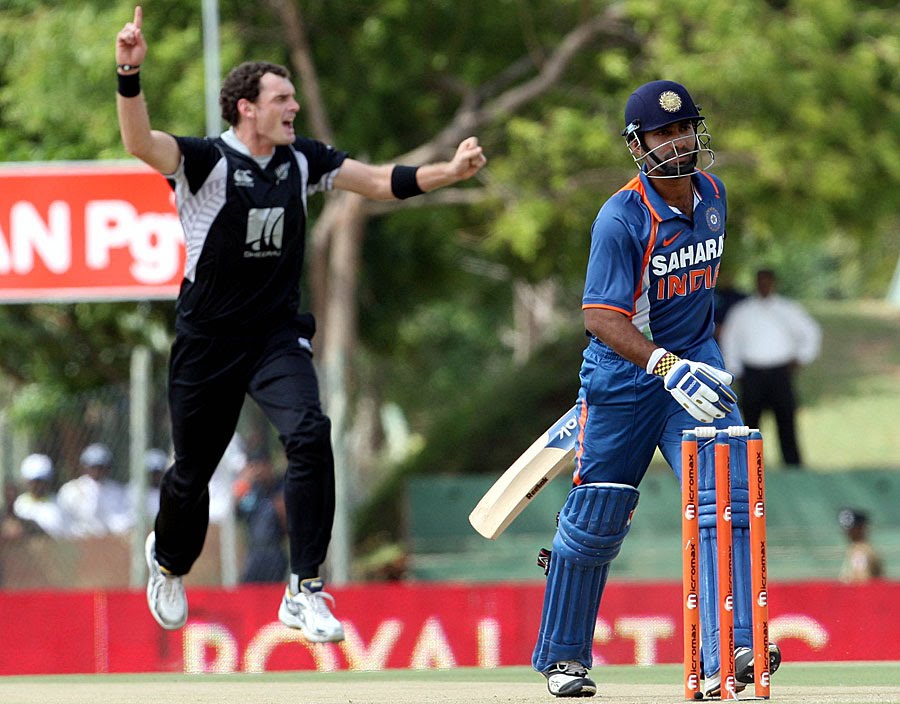
The ‘learned’ trio of Ian Chappell, Allan Donald and India’s own Sanjay Manjrekar had described the Indian bowling as the weakest in world cricket these days. Well if India’s second string of quickies were good enough to reduce New Zealand to 53 for eight before eventually bowling them out for 118 it reflected their potency more than anything else.

It was the quartet of Praveen Kumar, Ashish Nehra, Munaf Patel and Ishant Sharma who bowled superbly to engineer an impressive 105-run victory for India that took them to the final.

It’s not often that the Indians play four fast-medium bowlers in a game but the conditions in Dambulla prompted their think-tank to do away with the conventional strategy of relying on spinners.

The conditions at Dambulla were certainly in favour of the fast bowlers, particularly under lights, but they still needed to put the ball in right areas and create pressure in order to defend a modest total of 223.

Kumar started the slide and Nehra, who didn’t concede any run apart from three wides in as many overs, joined in the act soon. Sharma broke the threatening fifth wicket partnership before Patel removed three batsmen in quick succession to seal the fate of the game.

Only Sharma would have been a certainty if India were not handicapped by the injuries to their key fast bowlers. Zaheer Khan and Shantikumaran Sreesanth would definitely have carried the burden of attacking the opponents with the new ball, had they been fit.

Another ‘key’ element missing from the Indian bowling attack in Dambulla is the wily off-spinner Harbhajan Singh, whose vast experience of international cricket makes me an automatic choice in the playing eleven.

The Indian bowlers, unlike the South Africans, Australians and Englishmen, have had to bowl in very tough conditions at home. The pitches in India of late have heavily been loaded in favour of the batsmen and life has been tough for their own bowlers.

Well the Indian fast bowlers had to be grateful to Virender Sehwag for having given them the runs to play with in the crucial game against New Zealand. Had Sehwag not batted in the typically aggressive style of his to compile yet another ODI century, the Indians would have been in dire straits.

"Since I was in form, I thought I will score more than the others. If I take more strike, then there is a smaller chance of others getting out," the mercurial opener remarked after having played one of the greatest ODI knocks of his career.

"The wicket was behaving better today than it did in the other matches and I knew in the first couple of overs that if I applied myself and batted cautiously, then it will be a good track to bat on. So in the first few overs, I was just watching how the wicket was behaving and after that I started playing my shots. I knew once I start playing my shots, the bowlers will be on the back foot and they will give me more loose balls," he added.

readmore »»

August 24, 2010

South Africa, not Australia, have best bowling attack

.
1 comments

By Syed Khalid Mahmood

I came across an interesting discussion, featuring three former Test cricketers, in which the present day bowling attacks in world cricket was the subject.

The trio of Ian Chappell, Allan Donald and Sanjay Manjrekar shared their views and it was unsurprising to find them more or less on the same wavelength. But I have my reservations about their assessment.

They have rated South Africa and Australia as the best bowling attacks followed by that of Pakistan and England while pushing India and Sri Lanka to the bottom.

Manjrekar, for a moment, looked off-target if not totally out of mind in his observations. "When you look at bowling attacks from around the world Australia will still perhaps be No.1, because you can imagine that attack being pretty good on Indian conditions, in Sri Lanka as well," he was quoted as saying.

"Getting everything in the air, trying to beat batsmen in pace and not using the surface at all by bowling the ball full-that's where Australia are good. They have got Mitchell Johnson who uses the length well. Doug Bollinger is also quite happy pitching the ball up. Australia and South Africa to me are the attacks that can perhaps make an impression in all sorts of conditions," Manjrekar, whose own career was cut short because of adopting some strange tactics, contended.

I wish Manjrekar had watched the performance of the Australian fast bowlers, whom he has showered with so much praise, during the two-Test series against Pakistan earlier this summer. In their present form neither Johnson nor Bollinger deserved to be any frontline Test team.

Yes South Africa possess the standout pace attack that can demolish any batting line-up with brutal force. They are the only team in the world having both the new ball operators, Dale Steyn and Morne Morkel, genuinely quick.

South Africa are fortunate to be blessed with genuine fast bowlers in their ranks whose aggression tests the best of batters in the business. They have a formidable support cast as well with Jacques Kallis being a more than decent fifth bowler.

Australia have had the most lethal bowling in the world until Shane Warne and Glenn McGrath were around. After their departure they have tried different bowlers but neither of them has been consistent enough for a long period. Their domestic structure has kept throwing talented youngsters but they have a lot to prove at the international level.

I fully agree with Donald that England, with a strong pace attack and a successful spinner in Graeme Swann, remained formidable in home conditions only and they would indeed be tested in Australia later in the year.

"It will be very interesting for them to go to Australia during the Ashes and bowl on those flat pitches. With the new ball, they are pretty good. James Anderson is the bowler for me who really stands out in that regard. Stuart Broad is pretty much a line bowler, he's quite aggressive. But in conditions with the Kookaburra ball, they are going to need something off the deck as well. So they are going to be tested during the Ashes," Donald reckoned.

readmore »»

Recent Posts